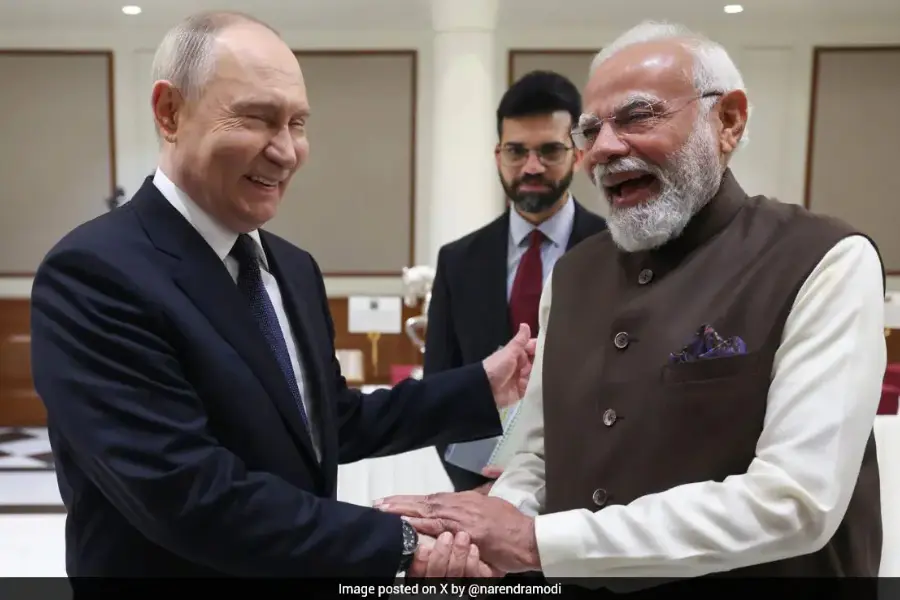
An international audience has expressed considerable interest in Vladimir Putin, Russian President, visit to India. Since it occurred at a time when there was little diplomatic movement towards resolving the ongoing conflict in Ukraine. Under pressure from different international sources, this visit also demonstrates continued development of the long lasting strategic partnership between both countries. This partnership has been in the news a lot lately around the world.
The welcome ceremony was very important because it shows how much importance both leaders place on their relationship. When Putin arrived in Delhi (Thursday night) he was greeted at the airport by Prime Minister Modi. After arriving, the two leaders went to a private dinner together. This further demonstrates how strong their relationship is and the value both leaders see in it.
Additionally, the agenda for Putin on Friday is very busy, but some of it includes:
- Ceremonial escort to Rashtrapati Bhavan (Presidential Palace)
- Meeting with President Droupadi Murmu (new President of India)
- Visit to Raj Ghat (Mahatma Gandhi Memorial)
- Participation at the Annual India/Russia Conference (the Hyderabad House)
- Meetings with Industry leaders and executives
- Leaving India around 9 p.m. after a busy 30 hours in India
According to the Kremlin, Putin’s visit to India was “very important” because of the extensive agenda. It encompasses defence, trade and strategic partnerships.
Some of the reasons this timing is important for Putin’s visit to India:
- Completion of 25 years of strategic partnership between India, Russia.
- Overall, the upcoming summit is the first since 2019. It follows postponements due to the conflict in Ukraine, as well as many diplomatic obstacles on a global scale.
- Tensions exist between India and the US, stemming from the tariffs that Washington is imposing and the sanctions that it has threatened. As a result of India’s continued purchase of discounted Russian crude oil.
- India’s position as a non-aligned nation has remained unchanged for many years but is being scrutinized. This is as India develops working relationships with both the US and Russia.
- India and Russia have a long history of defence cooperation, and defence is expected to be a major topic of discussion at the upcoming summit.
Russian defence equipment accounts for 36% of total arms imports into India and represents more than 60% of the current military stock of India.
Important topics that are expected to be discussed at the summit include:
- The possibility of acquiring additional S-400 missile defence systems. It is an air force official in India has referred to these systems as “game-changers”.
- Russia has proposed to India that it will supply fifth-generation Su-57 combat aircraft.
It is expected that India and Russia will continue to expand their defence and technology partnerships. Also, by developing strong defence relationships with India, Russia will be able to demonstrate to the world that it is not isolated as a result of the current geopolitical situation.
Post-2022, oil purchases from Russia have increased substantially (by 2,250%). India has become one of Russia’s top buyers of oil.
Despite the prior stability that energy commerce brought to the relationship between the two countries (India and Russia), analysts project that India’s import of oil from Russia will dip to a three-year low. It created problems for both sides. Russia and India also experienced a record level of trade between them this year (almost $69 billion). While their two-way trade is very unbalanced as is reflected in the huge deficit of approximately $64 billion in Russia’s shipping to India (primarily crude oil) versus the approximate $5 billion India has shipped to Russia.
Because of the significant trade deficit the goal of India and Russia to achieve a total trade volume of $100 billion by 2030 appears very problematic. Additionally, India seems to be positioned appropriately. Russia expects to face shortages of more than three million workers by 2030. As such India and Russia have undertaken joint projects where Indian laborers will migrate to Russia to fill this need.
A Delicate Diplomatic Balancing Act
Finally, India has difficulties maintaining balanced relations with competing factions (expected to be the US, the EU and Russia’s Eurasian Economic Union) while actively engaging in trade negotiations with all these entities.
If a peaceful settlement between Russia and Ukraine comes to fruition — still unknown at this moment in time — it should relieve any strain that has developed in India’s relationship with Russia and also the United States.
Putin’s recent visit to India confirms that the ties between India and Russia remain strong amid volatile global circumstances. By concentrating on military cooperation, expanding trade routes and establishing a comprehensive geopolitical strategy for both nations, India has achieved success developing these strong ties while maintaining an effective means of negotiating changes in complicated global relationships. The outcome of this trip will continue to influence the regional and international political scene for quite some time based on what has been revealed in recent news updates.