
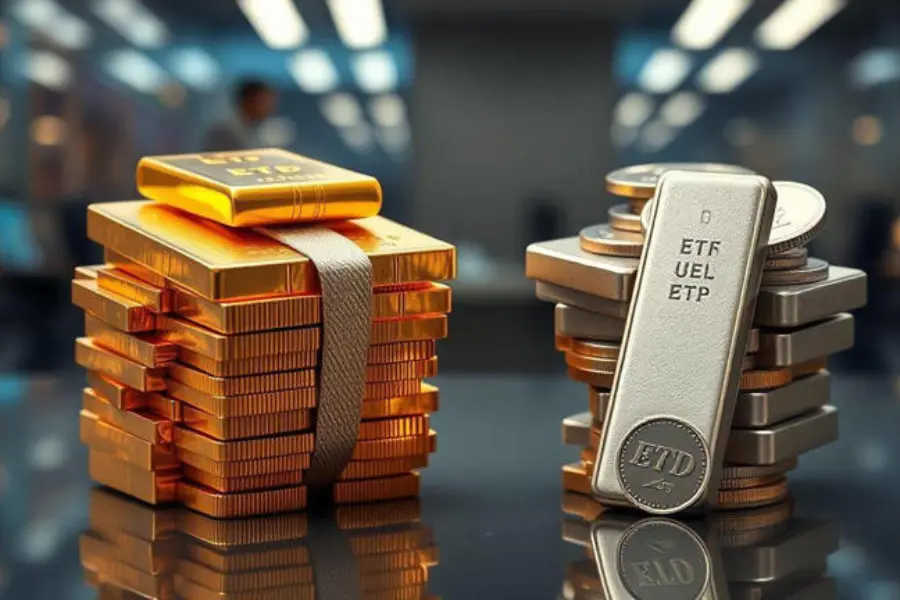
Gold and silver exchange-traded funds (ETFs) have dropped significantly on January 22nd. Following an exceptional rise that lifted precious metals to all-time highs at the beginning of the year. The downturn has sparked discussions among investors. It is regarding whether this should be interpreted as a buying opportunity or indicative of further declines to come.
The Downdraft on Precious Metal ETFs
Numerous precious metal ETFs saw substantial intraday declines ranging from over 20% for Tata Silver ETF and close to 12% for Birla Sun Life Gold ETF. Both ETF’s decline has closely mirrored the declines in spot gold and silver prices when global risk appetite decreased.
Market experts believe that the actions reflect a change in market sentiment. Rather than a break in fundamentals. For example, one analyst stated that the correction has primarily been driven by profit-taking and portfolio rebalancing as a result of sustained price gains. It is one of the most prevalent themes currently in the latest news on Business globally.
What Happened to Cause the Drop?
The decline was precipitated by a reduction in geopolitical tensions. U.S. President Donald Trump recently announced an agreement with NATO regarding Greenland. He subsequently backed off previous plans to implement tariffs on goods imported into the U.S. from Greenland.
According to Justin Khoo, Senior Market Analyst for VT Market, the dramatic decline in prices of some ETFs. With some choices dropping nearly 21%, was a result of changing investor sentiment, and not indicative of the collapse of precious metals. Although he argues that the price of precious metals remains relatively high when compared to prior historical highs. He also claims that the recent drop in prices should be viewed as a rebalancing of risk taken by investors when stock markets begin to climb.
Similarly, Siddharth Maurya, Founder and Managing Director of Vibhavangal Anukulakara, believes that the drop in ETF values were a result of profit-taking. They were influenced by the reversal of risk-off positions on metals reaching historic highs. He also believes that fluctuations in ETF values will be continual and frequent. While the market evolves relative to global economic developments.
Are investors smart capitalizing on a dip?
There remains a divide in the market on this question. According to Tanvi Kanchan, the Associate Director at Anand Rathi Share and Stock Brokers, some investors view current corrections as an opportunity to purchase. While others view current elevated pricing following price increases through 2025 as something that can continue to be maintained.
Kanchan stated further that the long-term fundamentals are continuing to be strong due to demand from solar, electric vehicle, AI infrastructure. However, she did recommend not to make lump-sum investments today. To spread out purchases over several weeks or months which will help minimize any timing risk.
For Conservative Allocations – advice to establish 5–10% of your total portfolio to either gold or silver ETFs. By method of systematic purchase, this provides less risk of volatility and retains exposure to asset classes that tend to perform well during geopolitical instability and shifting of monetary policy.
Harshal Dasani, Business Head at INVasset PMS stated that silver ETFs had a greater decline than MCX Silver as Speculation Premiums related to Expectations of the Budget unwinding from them.
With retail investors eager to secure profits, ETF prices responded more quickly.
With structural demand factors remaining stable but short-term sentiment still weak, analysts recommend careful accumulation instead of reckless speculation. For long-term investors, the current correction may offer strategic entry points—but patience will be key amid ongoing volatility.






**balmorex pro**
balmorex is an exceptional solution for individuals who suffer from chronic joint pain and muscle aches.
3kfs6w
Interesting points about skill-based gaming! It’s smart to focus on understanding mechanics, not just luck. A platform like abc8ph seems to prioritize that, with a focus on safe exploration & verification-a good sign!
66fbet dude, I tried it. Wasn’t blown away but it’s alright. Nothing groundbreaking, just another place to try your luck at. Give it a shot if you’re feeling lucky.. Check it out at 66fbet
About rabetapp– Heard the rumors, tried it out. User interface is very smooth, but didn’t turn out to be my jam. If you’re curious, check it out for yourself and be the judge.. Check it out at rabetapp
777dspecs, alright. It may not be everyone’s thing, but I enjoy it when I’m looking for something new. It’s okay, you might even get lucky! why not give it a go?. Check it out at 777dspecs
Comment: This analysis of precious metals ETFs highlights how geopolitical shifts rapidly impact investment strategies. Smart investors constantly adapt portfolios across markets – from traditional commodities to digital entertainment platforms where risk management algorithms power real-time experiences like those on the jiligames app. Diversification remains key during volatility.
[5027]fc178 Casino Philippines: Top Slots, Easy Register, Login & App Download Join fc178 Casino Philippines for the ultimate gaming experience! Enjoy fast fc178 register and fc178 login to access premium fc178 slot games. Get the fc178 download app today and start winning at the #1 fc178 casino. visit: fc178
7m cn ma cao? Been using it for ages. Pretty solid source for odds and results! Highly recommend if you’re into that sort of thing: 7m cn ma cao
For all my soccer fanatics out there, trying to find some 7m.cn.Ma Cao bóng đá updates? Hopefuly you’ll find what you are looking for here 7m.cn.ma cao bóng đá. Maybe we can all celebrate our winnings later.
Heard gachoic1com.com has the best information on gà đòn c1. Could be interesting, I’m checking it out!gà đòn c1
E aí galera! 123br is pretty cool. Easy to navigate and has some interesting content. If you’re looking for something new, give it a look. Worth a try, for sure. 123br
Alright guys, betchidocasino is where it’s at! Found some really cool stuff there. The site’s easy to use and has a good selection. Definitely worth checking out if you’re looking for something new. betchidocasino
What’s up people? Gave 28gbetapp a try and it’s pretty solid. The app is easy to use and the betting options are good. Might be worth your time if you’re into that sort of thing. Check it out! 28gbetapp