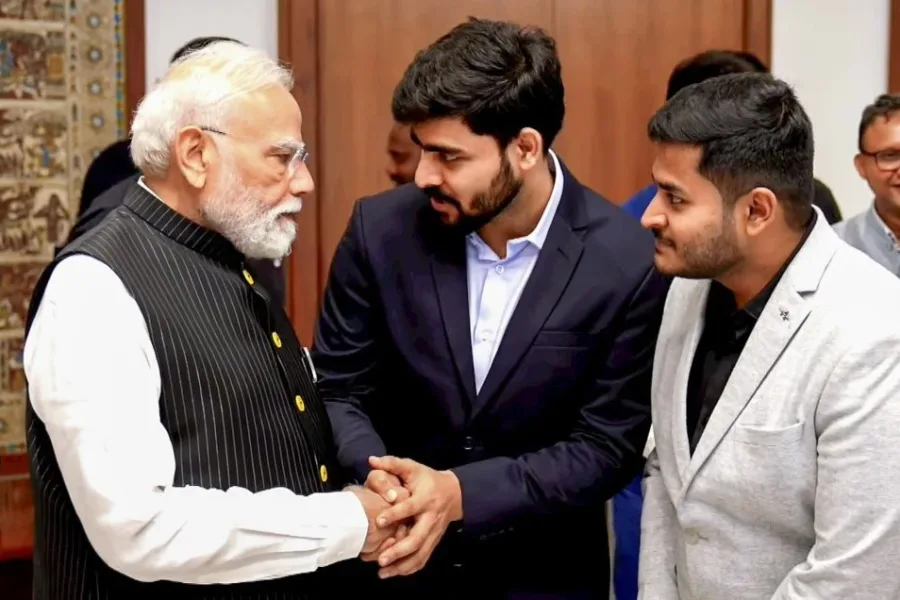
Indian Prime Minister Narendra Modi trusts that India can become an important player in the global race for space economy as it incentivizes private companies to create an ecosystem that entices global talent, investments, and innovations. Speaking to the CEO and founders of Indian space startups before National Space Day, Modi asserted that India can widen its share in the international space market.
The statement reflects the latest news for business sector, revealing India’s growing ambitions in the commercial space arena.
PM Modi Promotes the Development of Space Startup Environment
In his meeting with the leaders of around 20 private space companies, PM Modi said that it is important for India to create a favourable environment for foreign people to collaborate with Indian startups. According to the prime minister, India has many advantages when it comes to cost-efficient launching abilities, skilled labour, and strong entrepreneurship. Moreover, Modi pointed out that stable policies of the government have attracted the trust of the startups interested in investing in space.
India’s Strides in Space Industry
India started allowing private participation in the industry back in 2020 and has enabled the startups and private companies to build satellites, launch vehicles, and software solutions.
The progress has been astounding. According to government records, the number of private space startups has increased from one in 2014 to around 440 in 2026, owing to the 2023 Indian space policy, which helps create opportunities across the entire spectrum of the space sector.
The government plans to make India a world-class center for commercial space technology in the next decade.
Private Investments on the Rise
Currently, one can attribute around $9 billion towards India’s share in the global space economy of $600 billion, according to government prediction that the country’s space economy will reach between $40 and $45 billion in the next decade.
Private investments in India’s space industry are on the rise, as evident from the fact that the investment has gone up from $100.5 million in 2021-22 to $618.5 million by March 2026.
The recent developments are an important highlight in the recent technology in India about the Indian business environment, indicating that investors are getting increasingly interested in India’s space industry.
Space Startups Showcase Technologies of the Future
Numerous well-known startups, including Skyroot Aerospace, Agnikul Cosmos, Pixxel, Dhruva Space, and GalaxEye have attended the meeting and shared their ambitious plans for the future.
The technological improvements they suggested comprise robotic spacecrafts to take over inactive satellites, a technology to refuel satellites, space fuel stations, advanced propulsion systems and making medicine in space to bring back to Earth.
Skyroot Aerospace, which was first to launch a private rocket in India, also explained plans to accelerate the number of launches and expand operations internationally.
The Indian Position on the Global Space Economy
Modi stated that since India has already had achieved the leadership in costs, capabilities, and innovations, it means that India can compete on the global space stage. The prime minister pointed out that spectacular success of Indian start-ups will put India in a position of a leading provider of high technology in the field of space projects.