
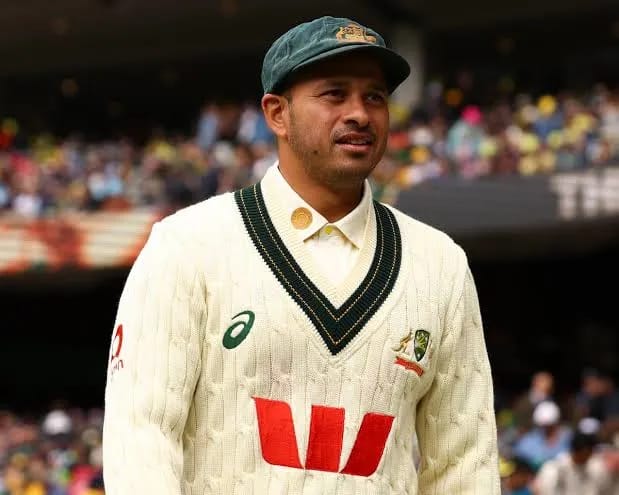
After a remarkable 15-year career filled with perseverance, success, and positive impact in his community, 39-year-old Australian cricketing legend Usman Khawaja has confirmed his retirement from the game of cricket. He concluded his official international playing career in the latest and final match of the 5-match Ashes Test Series. It was against England played at the SCG.
The Struggles and Achievements of Khawaja’s Journey
Khawaja’s journey began in Islamabad. He was taken to Australia where he was raised. It was not an easy road to the top. He will be remembered as not just Australia’s first Test cricketer of Pakistani descent, but the first Test cricketer of the Islamic religion. Throughout his career, he found himself in a unique position as being the only player of colour on many occasions. At one point in time, he was the only Asian player in all of Australian first-class cricket.
“I am a person of colour from Pakistan,” he says. It is a reminder to Khawaja of the struggles he faced because of racial and religious discrimination during his entire time as a player. Khawaja’s efforts on and off the field did not only add runs to the scoreboard. They also provided hope to young talented athletes with diverse backgrounds that they could pursue a career in professional sport as well.
Khawaja’s runs in Test cricket – 6206 in 87 Test matches. An average of 43.39 with a total of 16 centuries and the highest score of 232 scored in a Test against Sri Lanka. As an elite performer, Khawaja’s run performances speak for themselves and his level of perseverance is commendable. Khawaja has played 40 One Day Internationals for Australia and 9 Twenty20 Internationals.
Khawaja’s run performances have been very much in the sports news headlines today, particularly in the most important moments of The Ashes series. The easy-going temperament of his batting from the start of the batting order has been a stabilizing factor in the Australian batting.
A Challenging Final Ashes Series
The most recent edition of The Ashes series was a very difficult period for Khawaja due to the injury he suffered in the first Test in Perth. Due to the nature of his injury Khawaja was forced to sit out and bear the brunt of significant media speculation and judgment from his peers. To be referred to as “lazy” and “selfish”, all of which were the implications of a racial stereotype. He stated that the intense scrutiny over his inability to be fit to play due to his injury continued for several weeks. He considered it completely unwarranted. The period of scrutiny Khawaja endured following his inability to perform because of injury extended for weeks. But he felt that all scrutiny was unjustified. However, when Khawaja had the opportunity to contribute and play. He did perform an important role in his team’s achievements during Adelaide and Melbourne Tests.
“I Can Complete It on My Own Accord”
While Khawaja understands that not playing in the Adelaide Test signifies the end of his career. He appreciates that he will be able to retire on his own accord, at the SCG. This is the venue with the most sentimental value to Khawaja. “I feel fortunate to retire on my own terms, at my favourite venue, the SCG” stated Khawaja. Khawaja has a strong emotional attachment to being able to finish at the same place where it all started for him – 2011.
Outside of Cricket
Usman Khawaja has made his mark by being an advocate for other communities outside of cricket. It was through his charitable work at the Usman Khawaja Foundation. Through this foundation, youth from refugee, immigrant, Indigenous, and disadvantaged backgrounds have been able to access resources and opportunities to participate in cricket and other educational tools.
Todd Greenberg, CEO of Cricket Australia, acknowledged Khawaja’s significant contribution to society. He highlighted him as one of the finest and most determined batsmen of his generation. While also praising his significant contribution to society.
A Legacy That Will Endure
Usman Khawaja is in the final stages of preparing to play his final Test match. Throughout his career, he has displayed courage, excellence and an embodiment of diversity and representation. His journey will motivate and inspire many generations to come, and it will be remembered in the annals of Australian cricket history.