
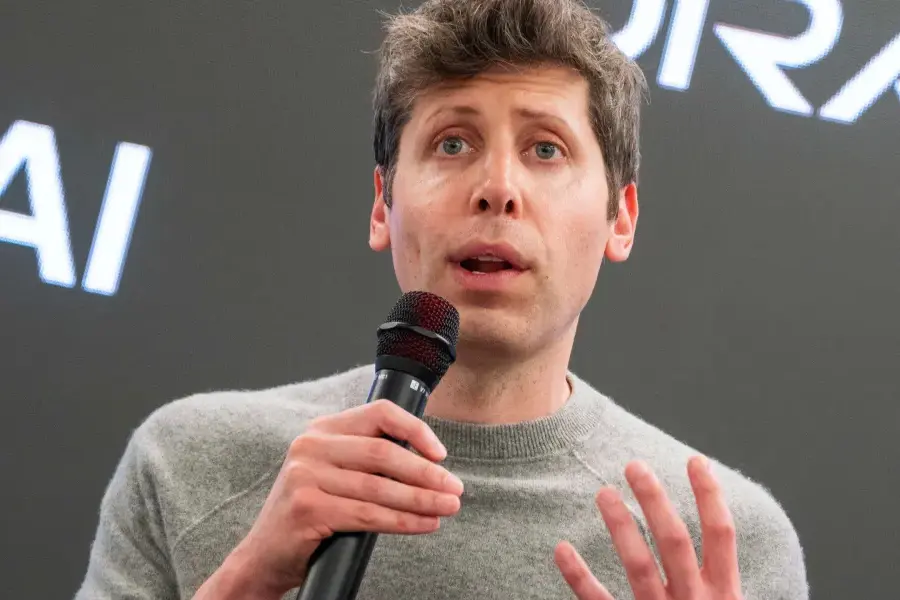
OpenAI’s CEO Sam Altman has drawn a lot of attention. It is after declaring his intention to have “zero percent interest” in continuing to be the CEO of a publicly traded company. These comments come at a time when there are increasing rumours of OpenAI taking steps for a potential initial public offering (IPO) within four years, as early as 2026. Altman’s comments have sparked much discussion within the global tech sector. Also, within the technology-savvy community in India, where OpenAI’s products are widely used within businesses, education and among startup companies.
Sam Altman’s candid comments about experience as a public company
Sam Altman recently spoke at an event and admitted that although OpenAI may eventually go public. The idea of operating a publicly traded company was not a pleasant concept to him. He insinuated that the position could be potentially “frustrating”. He expressed more of a desire to create and be innovative versus having to manage the pressures of the public marketplace.
As far as Altman’s personal opinion about the viability of taking OpenAI public, he stated that in all likelihood, to continue developing AI to its fullest potential. Going public would make sense as the public market will provide a broader “public” opportunity to create and grow the value of the company. To secure the capital that would be required to invest in developing advanced Artificial Intelligence (AI).
The Fast Growth of OpenAI Requires Funding
Since it’s establishment in 2022, ChatGPT has been able to reach about 800 million users every week for people around the world. It has entered into large contracts with various tech companies such as Microsoft, Oracle and Nvidia to name a few, amounting to nearly $1 trillion.
Reports indicate that OpenAI is reportedly in the early stages of exploring going public (IPO). Valuations are estimated in excess of $80 billion and more than $1 trillion. A Reuters report suggests that the company will most likely file for an IPO in the second half of 2026. It is with the prospect of initiating its stock market response sometime in 2027.
Transitioning From Charities To Businesses
When OpenAI was established as a non-profit organisation back in 2015, it had recently undergone a massive change in its structure to a traditional for-profit company in October to try and secure large investments. This was required to maintain the company’s competitiveness within the rapidly developing AI industry.
This structural transition has decreased Microsoft from being a majority to an estimated 27% stake of OpenAI. While continuing to expand the Company’s research capabilities and collaborating with other Cloud Computing companies outside of those Microsoft/Oracle/ Nviida. This change in structure is reflective of what we are now seeing with the recent Rise of Technology in India. Here, AI Start Ups can operate in conjunction with sustainable business practices to manage innovation.
Competitive Landscape and Strategic Focus
The competition level has increased dramatically throughout the AI industry. Especially since Google released the Gemini 3. After that, it was reported that Altman issued a “code red” to OpenAI. Therefore spent the next eight weeks intensively prioritizing developing OpenAI’s core product. This allowed OpenAI to release almost immediately after developing the GPT-5.2 model and a new image-to-text tool. This would compete with Google’s Nano Banana.
Fidji Simo, the CEO of OpenAI’s app, stated that the launch of these models was not an act of retaliation. However, established priorities have enabled us to develop faster.
Global Technology Framework Implications
Mr. Altman’s comments illustrate a fundamental dilemma facing many technical companies today. The need for a high cost of capital versus the cultural and operational challenges of going public. Developers, start-ups and corporations watching the recent technology in India will learn from OpenAI’s experience how the global leaders in AI are managing their growth, governance and competitive landscape.
As OpenAI moves closer to an IPO, all eyes are on how OpenAI will balance innovation with investor demands and the possibility that Sam Altman may step down from OpenAI once it goes public.
It’s fascinating how gaming evolved – from simple dice to complex online platforms! Seeing sites like spin ph com online casino prioritize player education & responsible play is a great step forward. Understanding game mechanics is key!
Mafia777pk is where it’s at! Big wins, good times. Definitely recommend if you’re lookin’ for some excitement. Don’t be a chump, check it out! mafia777pk
Hi there very nice website!! Guy .. Excellent .. Superb .. I’ll bookmark your web site and take the feeds alsoKI’m glad to search out numerous helpful information right here in the submit, we want work out extra strategies on this regard, thanks for sharing. . . . . .
U888U888COOL on .com, huh? Had some fun times there. Fair play and a smooth interface. Worth a peek. u888u888cool
I do agree with all of the ideas you have presented in your post. They’re very convincing and will definitely work. Still, the posts are very short for novices. Could you please extend them a little from next time? Thanks for the post.
wjpeso https://www.wwjpeso.com
I would like to thnkx for the efforts you’ve put in writing this website. I’m hoping the same high-grade site post from you in the upcoming also. In fact your creative writing skills has inspired me to get my own website now. Actually the blogging is spreading its wings quickly. Your write up is a good example of it.
I have been examinating out some of your articles and i must say nice stuff. I will make sure to bookmark your blog.
I love looking through and I believe this website got some really useful stuff on it! .
Today, while I was at work, my cousin stole my iPad and tested to see if it can survive a forty foot drop, just so she can be a youtube sensation. My apple ipad is now broken and she has 83 views. I know this is entirely off topic but I had to share it with someone!
I appreciate, cause I found exactly what I was looking for. You have ended my 4 day long hunt! God Bless you man. Have a nice day. Bye